These are three of the kidney cancers we treated by embolization and cryoablation.
A small tumor at the edge of the kidney can be straightforward to freeze. A tumor deep in the kidney can be hard to see on the CT used to place the probes. Embolizing it first with iodized oil can leave the tumor outlined on that scan. That gives you a target when you come back to freeze it.1
The other reason is bleeding. A large renal cell cancer can have a substantial blood supply, and the probe tracks can bleed when the probes come out. Embolization lets you close the branches feeding the tumor while preserving flow to the rest of the kidney. In one small study of tumors 5 cm or larger, the average hematoma after cryoablation was 18 mL in the four patients embolized first and 357 mL in the six treated with cryoablation alone.2 A later small matched study found no clear benefit.3
One man had a tumor at the back of his right kidney. His other medical problems made surgery too risky. We embolized the vessels feeding the tumor, and the rest of the kidney stayed perfused. We froze the tumor a month later. At two years, all that remained on CT was a small scar. Embolization and cryoablation of a right renal cell cancer
Another man had already lost his left kidney to cancer. Now he had a large upper-pole tumor in his only kidney. The month between embolization and cryoablation gave the tumor time to shrink. He kept his kidney and stayed off dialysis. Treating renal cell cancer in a solitary kidney
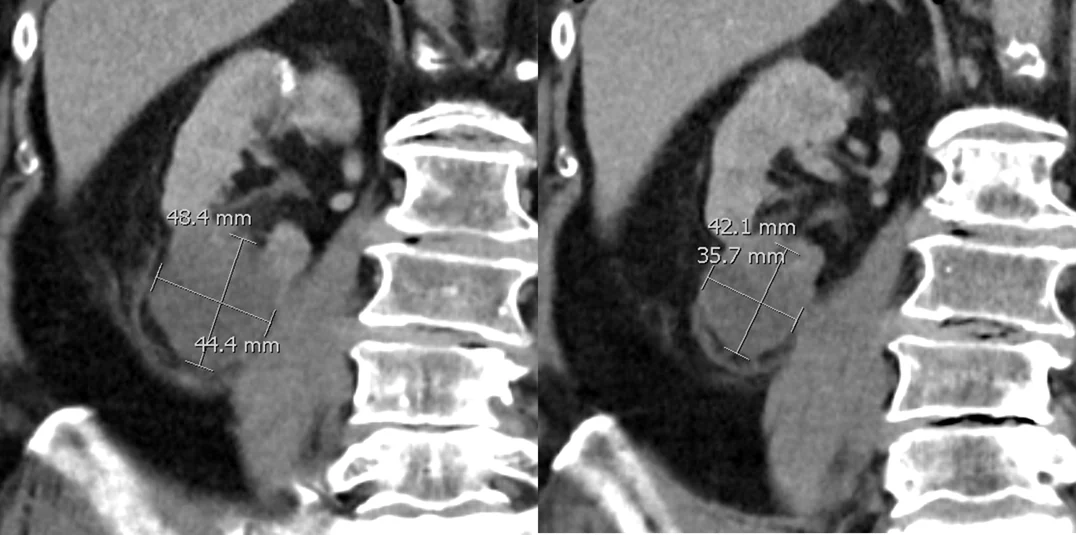
The third patient had a tumor at the lower pole of the right kidney. These are the measurements before and after treatment.
References
- Kobe A, Tselikas L, Deschamps F, et al. Thermal ablation combined with selective transarterial embolization of centrally located renal cell carcinomas measuring 3 cm or larger. Cardiovasc Intervent Radiol. 2022;45(3):371–379. https://doi.org/10.1007/s00270-021-03036-4
- Woodrum DA, Atwell TD, Farrell MA, Andrews JC, Charboneau JW, Callstrom MR. Role of intraarterial embolization before cryoablation of large renal tumors: a pilot study. J Vasc Interv Radiol. 2010;21(6):930–936. https://doi.org/10.1016/j.jvir.2010.02.015
- Gunn AJ, Mullenbach BJ, Poundstone MM, Gordetsky JB, Underwood ES, Rais-Bahrami S. Transarterial embolization of renal cell carcinoma as an adjunctive therapy prior to cryoablation: a propensity score matching analysis. Diagn Interv Radiol. 2018;24(6):357–363. https://doi.org/10.5152/dir.2018.18090