The calcified cap of a chronic total occlusion, a long-standing complete blockage, can be very difficult to cross while staying in the lumen, the channel of the artery. Persisting can create a large subintimal space within the wall of the artery, and a false lumen. Sharp recanalization, with the back end of a wire or with a needle, is useful when conventional crossing fails. It allows completion of otherwise technically impossible lesions.
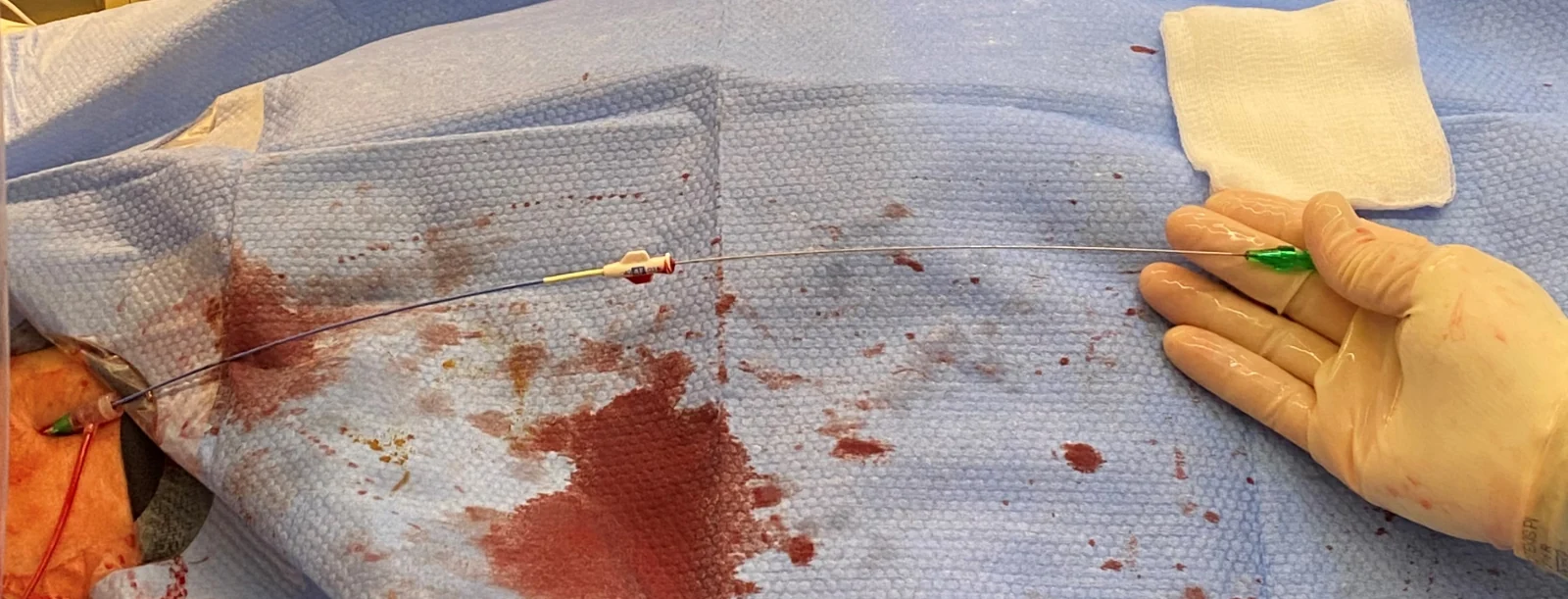
How I cross. I start with a crossing strategy: the wire (an .035 Glidewire, angled or straight, or an .014 or .018 wire), a support catheter, antegrade or retrograde access (from above or from below), and an escalation plan. Then I iterate quickly. When conventional crossing fails, the back end of an .035 Glidewire is often a great first choice.
The back end of a wire
The back end of an .035 Glidewire, regular or stiff, is relatively blunt and cannot be shaped. It tends to stay in the lumen and does not create a large subintimal space. It can be supported by a balloon, or run through a 4 French diagnostic catheter with retrograde access as the backup option.
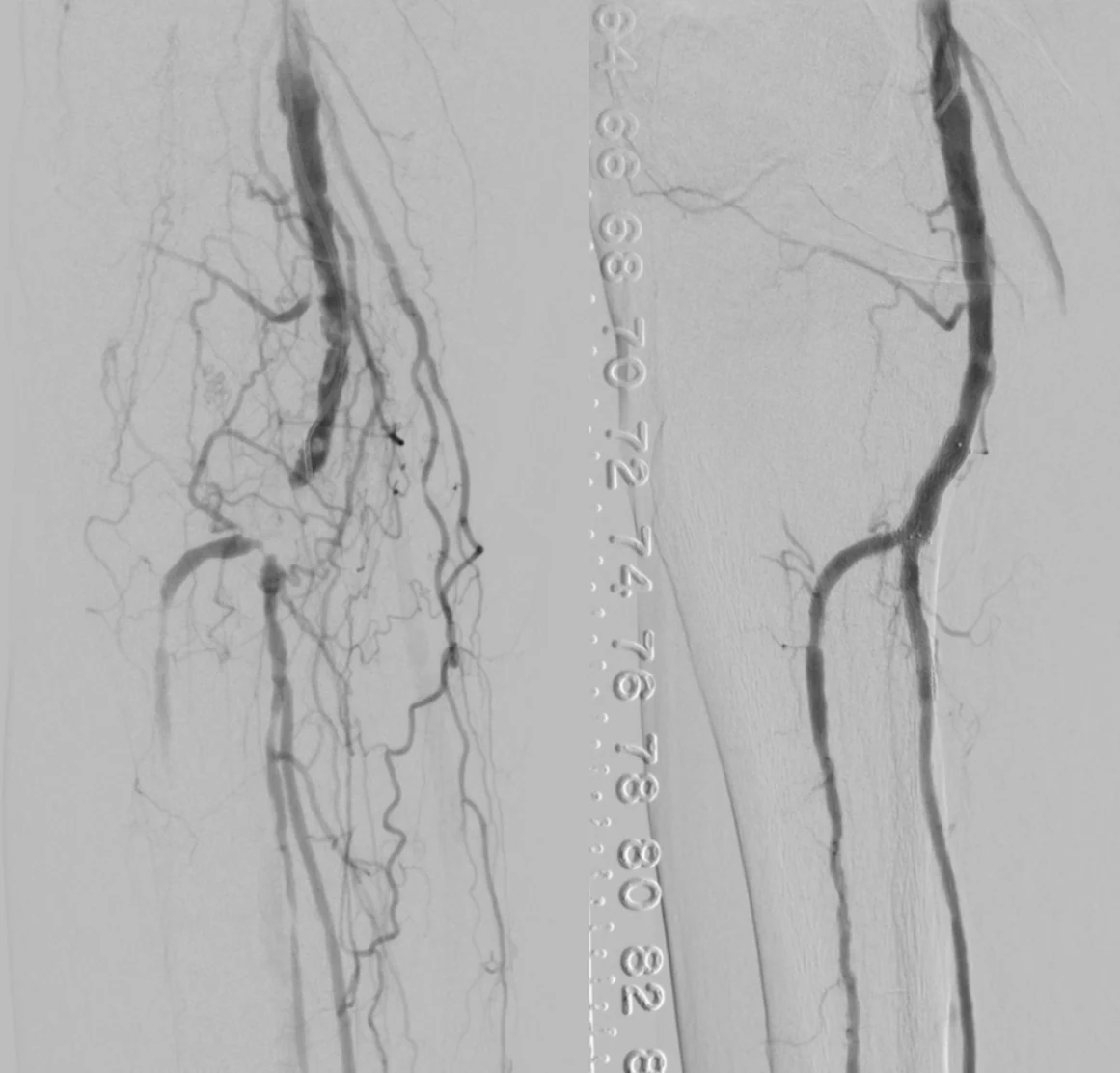
In the second patient, the trifurcation, where the popliteal artery divides into the arteries of the calf, was then reconstructed: a short bare nitinol self-expanding stent in the popliteal artery, delivered with its nose cone cut off, and kissing drug-eluting stents into the anterior tibial artery and tibioperoneal trunk.
The back end of an .014 or .018 stainless steel wire is sharp and can be shaped. It goes outside the lumen more easily, but it does not create a large subintimal space either. It is the next step when the Glidewire still cannot cross.
The Chiba needle
Needle recanalization is truly sharp. The Chiba needle comes in 20 cm and 65 cm lengths. It can be shaped for directional control, it transmits torque 1:1, and it has force and penetration power. It is .035 compatible: it can be delivered over an .014 or .018 wire, or through an .035 diagnostic catheter. It is a simple, cheap and effective tool for crossing difficult occlusions. Staying in the true lumen eliminates the need for re-entry devices, retrograde access and other time-consuming techniques.
In a woman in her 90s with ischemic foot ulcers, catheters, wires and the back end of an .014 wire could not cross a heavily calcified occlusion of the superficial femoral artery. A 65 cm 21-gauge Chiba needle placed through a 40 cm 4 French catheter crossed it.
From below, and at a target
In one trifurcation occlusion, a Chiba needle from a retrograde posterior tibial artery puncture targeted the catheter from above.
In thrombosed popliteal artery aneurysms, standard technique failed even with antegrade superficial femoral and retrograde posterior tibial access. From above, a 21-gauge 65 cm Chiba needle with a slight bend, placed through a 40 cm Kumpe catheter, gave through-and-through access. Intravascular ultrasound then confirmed the luminal location.
The needle can also aim at a balloon. In a CERAB reconstruction (covered endovascular reconstruction of the aortic bifurcation) for occlusion of the infrarenal aorta and both common iliac arteries, the aorta could be entered from the left but not from the right. A 20 cm 21-gauge Chiba needle, aimed at an 8 mm balloon inflated from the left, established access from the right.