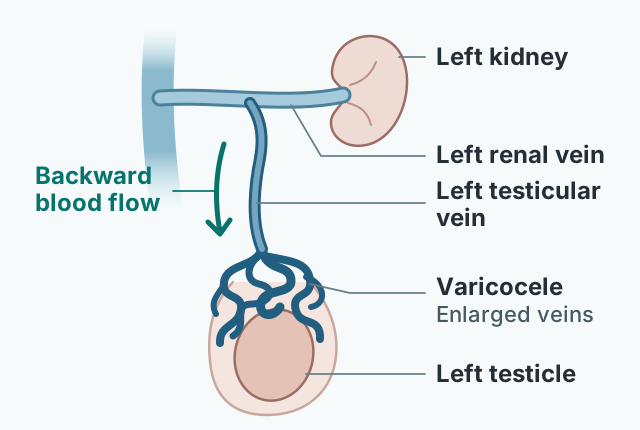
A varicocele is a collection of enlarged veins around the testicle. It is the same problem as varicose veins of the leg. The veins that carry blood from the testicle back to the heart have one-way valves. When the valves fail, blood flows the wrong way, down toward the testicle, the pressure in the veins rises, and they stretch and swell.
Varicoceles cause testicular pain and swelling, and over time they can shrink the testicle and reduce fertility. The goal of treatment is to close the leaking veins, so that blood drains out of the testicle through its normal veins.
Skill matters. There are two treatments: surgery (varicocelectomy) and embolization. Both can work well. Published success rates for both surgery and embolization vary widely, and experience counts, as does skill. When an experienced interventional radiologist does the embolization, the results are excellent. Find an interventional radiologist with great outcomes.
Symptoms
- Pain in the groin or testicle, from a dull ache to a sharp pain
- Pain that is worse with standing, exertion or heavy lifting
- Pain that builds through the day
- Relief when lying down
- Swelling around the testicle, which can look or feel like a bag of worms
- A testicle that becomes smaller over time
- Lower sperm count and poorer sperm quality, leading to infertility
Left and right
Varicoceles are common: one is found in about 15 in 100 healthy men, and in up to 35 in 100 men with primary infertility.1 They are more common on the left side. Many men have them on both sides, and a varicocele on the right side alone is unusual.
Why the left side is more often affected. The left testicular vein (also called the gonadal vein) drains into the left renal vein, which carries blood away from the left kidney. The right testicular vein usually drains directly into the inferior vena cava, the large vein that carries blood back to the heart.2 If the valves leak, the taller column of blood on the left can put more pressure on the veins around the testicle when you stand. That helps explain why backward flow is more common on the left. Valves can leak on either side.3
Why the right side is harder to treat. The same anatomy makes the right testicular vein harder to find and to enter with a catheter: it joins the vena cava directly, at a sharp angle, just below the vein from the right kidney.4 In published series, embolization fails more often on the right. In one series of 158 men, the right testicular vein could not be closed in 18.9% of attempts, against 3.2% on the left.5
Why it matters
The enlarged veins raise the temperature of the testicle, and that affects sperm production. In teenage boys a varicocele is a common cause of a shrinking testicle and may affect fertility later. Treating it relieves or removes the pain and should be considered to protect the testicle and fertility.
Repair can make a practical difference to a couple trying to conceive. In a study of 373 men with a varicocele treated by surgery or embolization, the motile sperm count rose after treatment. Among men whose count was low enough that IVF was the couple's likely route, more than half improved enough to try a less invasive form of assisted reproduction or natural conception.6
How it is diagnosed
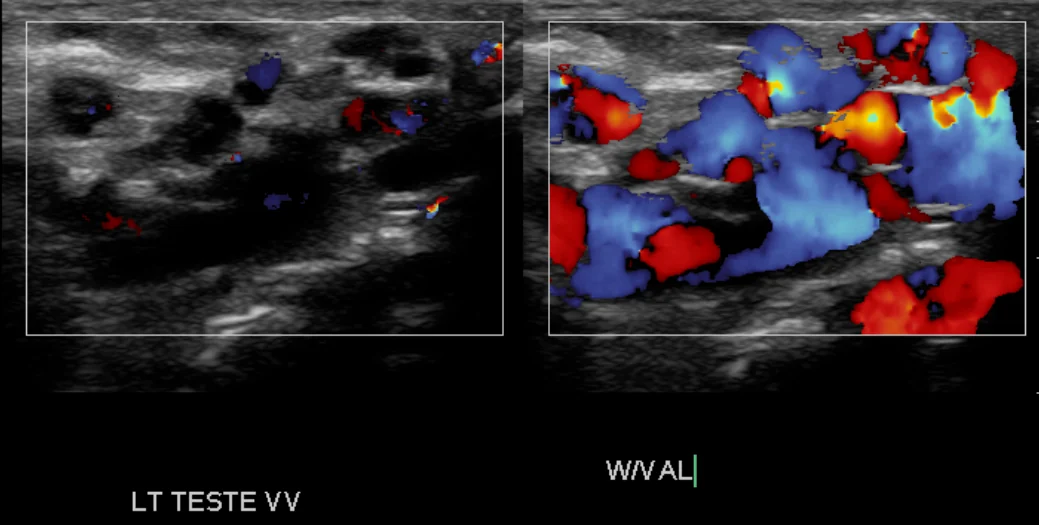
A varicocele is usually suspected on examination and confirmed by ultrasound of the testicles. Swelling in the scrotum has many causes, and ultrasound is the best way to identify and grade a varicocele.
When the vein that needs treatment is hard to find, CT venography maps the veins before a second attempt.7
Treatment
Varicocelectomy ties off the abnormal veins through an incision in the groin, often under a general anesthetic. Varicoceles on both sides need two incisions.
Varicocele embolization closes the leaking vein from inside. A vein is reached through a needle puncture, under local anesthetic and light sedation. A thin tube (catheter) is guided on live X-ray into the testicular vein that is leaking into the varicocele. The vein is closed with small metal coils, often with a foam sclerosant (a medicine that seals the vein) injected first into its lower part. Blood then drains out of the testicle through its normal veins. Compared with surgery:
- There is no incision in the groin or scrotum, and no stitches.
- There is no general anesthetic.
- Varicoceles on both sides can be treated at the same time, through one puncture.
- There is less pain afterwards, and a faster return to work and daily life.
- With no wound, there is less chance of infection.
- It is as effective as surgery at improving semen quality and pregnancy rates.
The uncoil coil. The usual method packs many small coils into the vein, each one closing only a short segment. The uncoil coil technique closes the vein with two or three large, long coils laid along it. In 22 consecutive patients it used a mean of 2.5 coils per side, against 4.7 in 25 earlier packing procedures by the same operator, with no immediate complications.7,8 One man had a painful clot in the varicocele that settled over two months, and none had new groin pain from the coils.8 The same technique is used for the ovarian veins in pelvic venous disease.
Testicular pain can have more than one cause, and correcting a varicocele does not always relieve it.
Two cases show the range. A teenage athlete whose painful varicoceles on both sides were interfering with sports wanted the procedure with the fastest recovery and the best outcomes; both sides were treated with embolization and foam sclerotherapy (painful varicoceles in a high school athlete). In the other, a varicocele came back because only the upper part of the vein had been closed at an earlier embolization. In that patient compression of the left renal vein had opened new channels into the untreated part of the vein. Closing the rest of the vein relieved his symptoms (recurrent varicocele after incomplete embolization).
References
- Alsaikhan B, Alrabeeah K, Delouya G, Zini A. Epidemiology of varicocele. Asian J Androl. 2016;18(2):179–181. https://doi.org/10.4103/1008-682X.172640
- Kara T, Younes M, Erol B, Karcaaltincaba M. Evaluation of testicular vein anatomy with multidetector computed tomography. Surg Radiol Anat. 2012;34(4):341–345. https://doi.org/10.1007/s00276-011-0898-3
- Gat Y, Zukerman Z, Chakraborty J, Gornish M. Varicocele, hypoxia and male infertility. Fluid mechanics analysis of the impaired testicular venous drainage system. Hum Reprod. 2005;20(9):2614–2619. https://doi.org/10.1093/humrep/dei089
- Halpern J, Mittal S, Pereira K, Bhatia S, Ramasamy R. Percutaneous embolization of varicocele: technique, indications, relative contraindications, and complications. Asian J Androl. 2016;18(2):234–238. https://doi.org/10.4103/1008-682X.169985
- Cassidy D, Jarvi K, Grober E, Lo K. Varicocele surgery or embolization: which is better? Can Urol Assoc J. 2012;6(4):266–268. https://pubmed.ncbi.nlm.nih.gov/23093537/
- Samplaski MK, Lo KC, Grober ED, Zini A, Jarvi KA. Varicocelectomy to “upgrade” semen quality to allow couples to use less invasive forms of assisted reproductive technology. Fertil Steril. 2017;108(4):609–612. https://doi.org/10.1016/j.fertnstert.2017.07.017
- Rostambeigi N, Allen G, Braun N, Golzarian J, Cumming M. Novel “uncoil coil” technique for varicocele embolization. Presented at: Global Embolization Symposium and Technologies (GEST); 2018; Miami, FL.
- Cumming M. The uncoil coil for varicocele embolization. Presented at: Global Embolization Symposium and Technologies (GEST); 2018; Miami, FL.